
Guiding Question: How do educators in Uruguay adapt curriculum and
instruction to keep pace with rapidly evolving technology?
Develop Training
Programs

Online courses available
Certification options offered
Foster Community Connections
Workshops and seminars
Local collaboration groups
Implement Integration Practices
Framework adaptation plans
Regular feedback mechanisms
Understanding Global Education
Global education helps students develop the knowledge, skills, values, and dispositions needed to understand an interconnected world and participate throughtfully within it. For educators, global learning begins by creating opportunities for students to investigate meaningful issues, consider perspectives beyond their own, communicate with others, and apply their learning through action.
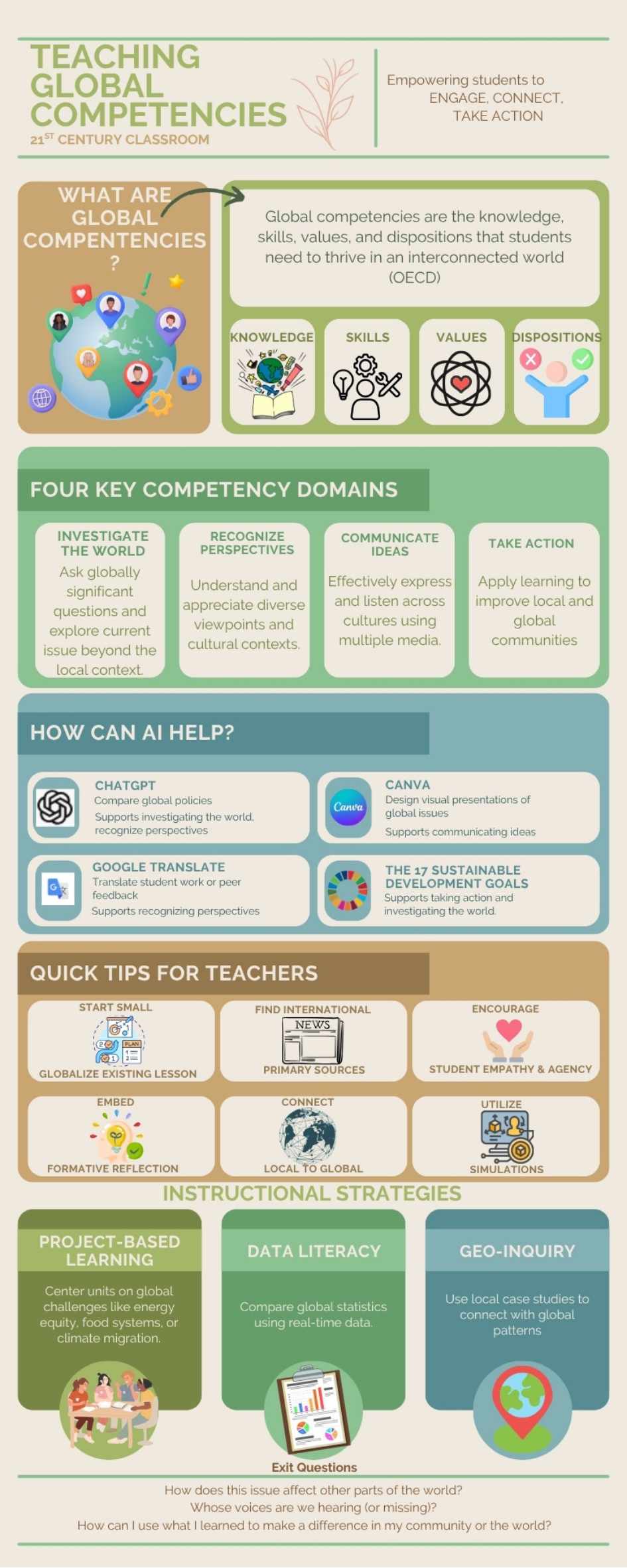
What Is Global Competence?
Global competence is the ability to understand issues beyond one’s immediate experience, consider how those issues may be viewed from different perspectives, communicate ideas across cultural and geographic boundaries, and use knowledge to contribute meaningfully to local and global communities.
For students, becoming globally competent does not require international travel. It begins with curiosity: asking why something happens, whose perspective may be missing, how a local issue connects to a larger system, and what actions might improve conditions.
Global Education Resources
- Asia Society – Plan With a Global Framework
- Asia Society’s work provides a practical framework for helping students investigate the world, recognize perspectives, communicate ideas, and take action. I recommend starting here if you are new to global education because these four dimensions can be applied across content areas without creating an entirely separate curriculum.
- World Savvy – Build competencies and dispositions
- World Savvy’s Global Competence Matrix expands global learning beyond knowledge of world events to include skills, behaviors, values, and attitudes. Its emphasis on inquiry, perspective-taking, collaboration, evidence-based thinking, empathy, and responsible action makes it especially useful when planning student-centered learning. The matrix specifically describes global competence as the skills and dispositions people need to thrive in an interconnected world.
- OECD – Understand the research
- OCED provides the research base behind global competence through PISA and resources such as Big Picture Thinking. Its framework emphasizes examining global and intercultural issues, understanding perspectives, interacting across cultures, and taking action for collective well-being and sustainable development. I would recommend OECD when educators want to understand the research and rationale behind global education, not just find an activity.
- Generation Global – Strengthen dialogue
- Generation Global offers practical resources for helping students communicate respectfully across cultures, beliefs, and perspectives. Its Essentials of Dialogue materials include strategies, classroom activities, reflection tools, and guidance for building connections with students beyond the classroom. This is an especially strong resource for teachers who want to develop communication, listening, empathy, and perspective-taking.
- Project Zero – Make thinking visible
- Project Zero at the Harvard Graduate School of Education offers thinking routines that can be incorporated into almost any lesson. Tools such as Connect, Extend, Challenge help students make connections, reflect on new learning, and identify questions that remain. Project Zero’s global thinking routines also support perspective-taking, questioning, and connecting classroom learning to the wider world.
You do not have to use all resources at once. Choose the organization that addresses the area you want to strengthen first, such as lesson design, global competence, dialogue, perspective-taking, or assessment, and begin there. Global education can grow through small, intentional changes to the teaching you already do.
Four Domains for Developing Thinking Habits
INVESTIGATING THE WORLD:
Ask meaningful questions and explore issues beyond local context.
RECOGNIZE PERSPCTIVES:
Consider how culture, experience, geography, and other factors influence the way people understand an issue.
COMMUNICATE IDEAS:
Share and interpret effectively with diverse audiences using appropriate language, media, and methods.
TAKE ACTION:
Apply learning to make informed decisions and contribute positive change in local and global communities.
Assessing World Competence
How do we know students are growing?
EXPLORE THE TOOL
WHAT IS IT?
WHY I RECOMMEND IT
A portfolio-based approach in which students collect evidence of their learning over time and connect their work to “I can” statements aligned with the four dimensions of global competence.
I like this approach because global competence develops over time. A portfolio allows students and teachers to see that growth through authentic work rather than relying on one assessment. It could also be incorporated into projects and assignments teachers are using instead of requiring an entirely separate assignment.
A framework containing observable descriptors for competencies such as listening to others, recognizing different perspectives, and responding appropriately across cultural contexts.
This resource helps make something abstract-global competence-more observable. Teachers can use the descriptors when developing rubrics, observing discussions, or evaluating collaborative activities. I especially like it for assessing skills that may be demonstrated through student interactions rather than through a written test.
An observable approach that encourages educators to document evidence of global competence when it appears naturally in students’ behaviors and interactions, including informal and unprompted situations.
Not every sign of global competence occurs during a planned assessment. Students may demonstrate curiosity, empathy, inclusion, or perspective-taking in moments we did not design for them. This tool reminds educators to notice and document those moments, giving a fuller picture of student growth.
Learn More: Foundational Resources for Global Educators
GLOBAL COMPETENCE
OECD: Big Picture Thinking:
How to Educate the Whole Person for an Interconnected World.
This resource connects global competence to curriculum, instruction, and learning environments. It helped me understand global competence as more than knowledge about other countries. Students need opportunities to examine issues, understand perspectives, communicate across differences, and take meaningful action.
WHY I RECOMMEND IT:
Start here if you want the research and conceptual foundation behind global education. The classroom cases also show what these ideas can look like across different subjects and settings.
PERSPECTIVE TAKING
National Geographic Education:
Exploring Perspectives
This tool encourages learners to examine an issue through multiple lenses, including spacial, cultural, political, economic, historical, geological, and ecological perspectives.
WHY I RECOMMEND IT:
I like this resource because it gives teachers a simple way to broaden an existing lesson. Asking students to reconsider the same issue through another lens can reveal connections and perspectives that might otherwise be missed.
MEDIA LITERACY
NAMLE:
Key Questions to Ask When Analyzing Media Experiences
NAMLE provides questions that help students examine authorship, purpose, audience, credibility, missing perspectives, interpretation, and the influence of media formats and technologies. The framework also asks students to consider what perspectives are present or absent and how different people might interpret the same message.
WHY I RECOMMEND IT:
Students encounter global issues through social media, news, video, and other digital sources every day. This resource gives them a practical structure for questioning what they see instead of simply accepting information at face value.
LOCAL TO GLOBAL
Getting Smart & Teton Science Schools
What is Place-Based Education
Why does it matter?
Place-based education uses local knowledge, communities, environments, and issues as meaningful contexts for learning. The resource emphasizes authentic projects that develop problem-solving, collaboration, community connection, environmental responsibility, and students’ capacity to become change-makers.
WHY I RECOMMEND IT
This resource helped reinforce one of my strongest takeaways from Fulbright: students do not need to travel internationally to learn globally. Their own community can provide the starting point for investigating systems and issues that extend far beyond it.
COMMUNICATION
Participate Learning
Teaching Communication Skills in K-12: Strategies that Build Career-Ready Students.
This resource connects communication with both global competence and career readiness. Students learn to adjust messages for different audiences, listen with empathy, collaborate, explain their thinking, and communicate effectively wiht people from different backgrounds.
WHY I RECOMMEND IT:
Communication is especially relevant for STEM and career-focused classrooms because technical knowledge alone is not enough. Students must also be able to explain ideas, collaborate with others, listen carefully, and adapt their communication to different audiences and contexts.