
How can I make curriculum I already teach more global?
Global education does not require teachers to abandon their existing curriculum or add an entirely new unit. Instead, educators can create opportunities for students to investigate issues from multiple perspectives, make connections beyond immediate community, communicate with others, and apply their learning to authentic practice. The goal is to help students learn through a global context.
START WITH WHAT YOU TEACH
Teaches can globalize existing lessons by changing the context, question, data, audience, or perspective without changing the required content.
Compare how communities in different countries address energy, water, climate, or environmental challenges.
Examine how technology, workforce needs, manufacturing, or infrastructure differ across countries.
Consider how culture and perspective technology, workforce needs, manufacturing, or infrastructure differ across countries.
Examine an issue through multiple national or cultural perspectives
Use authentic international data to investigate a common problem.
Ask yourself: Where could I add another perspective without adding another unit?
LOCAL COMMUNITY RESOURCES
CONNECTING lOCAL INDUSTRY TO GLOBAL LEARNING
Why I recommend it:
Cobb EMC is an existing partner in my Energy & Power pathway and provides students with access to professionals working directly in the energy industry. Its involvement with our program has included opportunities for industry connections, service, and authentic career learning.
Global learning connection:
Students can use a local electric cooperative as a starting point for comparing how electricity is generated, distributed, regulated, and financed in different regions of the United States and around the world. Topics such as grid reliability, renewable energy, energy equity, disaster response, and changing electricity demand can move easily from local observations to global comparisons.
Ideas for educators:
Industry speakers, facility or visits, grid/infrastructure case studies, energy-equity comparisons, service-learning projects
Why I recommend it:
Georgia Power provides another opportunity to connect classroom learning with the large-scale systems required to provide reliable electricity. Having an education representative already connected to the advisory committee creates an accessible pathway for bringing industry expertise into student learning.
Global learning connection:
Students can compare Georgia’s energy portfolio and infrastructure decisions with those of other states and countries. Nuclear energy, renewable integration, transmission, environmental impacts, reliability, and energy policy all provide opportunities to investigate how geography, economics resources, and public priorities influence energy choices.
Ideas for educators:
Guest speakers, power-generation comparisons, sustainability investigations, nuclear/renewable-energy discussions, workforce & career exploration
Why I recommend it:
The Southeast Lineman Training Center provides direct connection between classroom instruction and the skilled workforce responsible for constructing and maintaining electrical infrastructure.
Global learning connection:
Electrical infrastructure is a global workforce issue. Students can investigate how different countries build and maintain electrical grids, respond to natural disasters, address worker safety, expand access to electricity, and prepare technicians for rapidly changing energy systems.
Ideas for educators:
Career speakers, safety comparisons, workforce-development research, grid-resilience investigations, comparisons of electrical access & infrastructure across countries
Design for the four global Competencies
- Investigate the World – What can students investigate?
- Give students authentic questions, data, problems, or phenomena that extend beyond their immediate experience.
- Recognize Perspectives – Whose perspective is missing?
- Ask students to consider why people in different communities might understand or approach the same issue differently.
- Communicate Ideas – Who could students communicate with?
- Create authentic audiences for student work and opportunities to communicate across cultures when possible.
- Take Action – What could students do with what they learned?
- Move students from understanding a problem toward proposing, designing, evaluating, or implementing possible solutions.
Strategies You Can Use Tomorrow
Step 01: Globalize What You teach
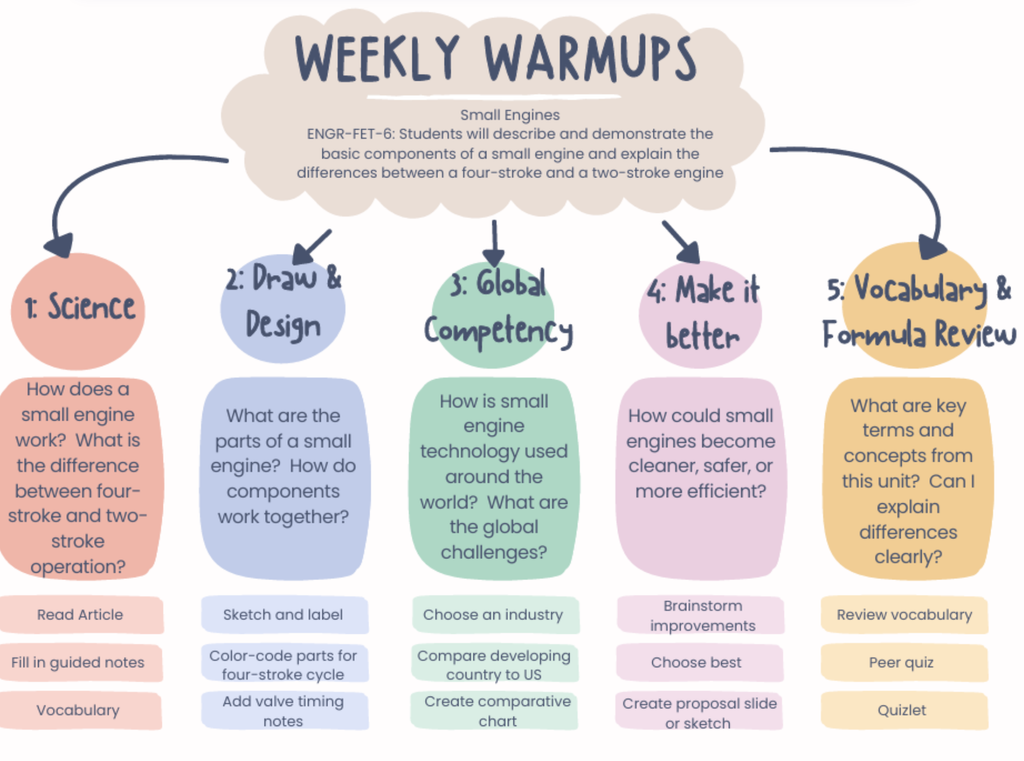
Try it: Choose one lesson you already teach and add a global comparison. In my small-engine unit, students firt learn the science and components, then investigate how small-engine technology is used around the world and compare its use different contexts. Global education does not have to mean more curriculum.
Step 02: Connect Local Problems to Global Systems: Geoinquiry & Authentic Problem-Solving
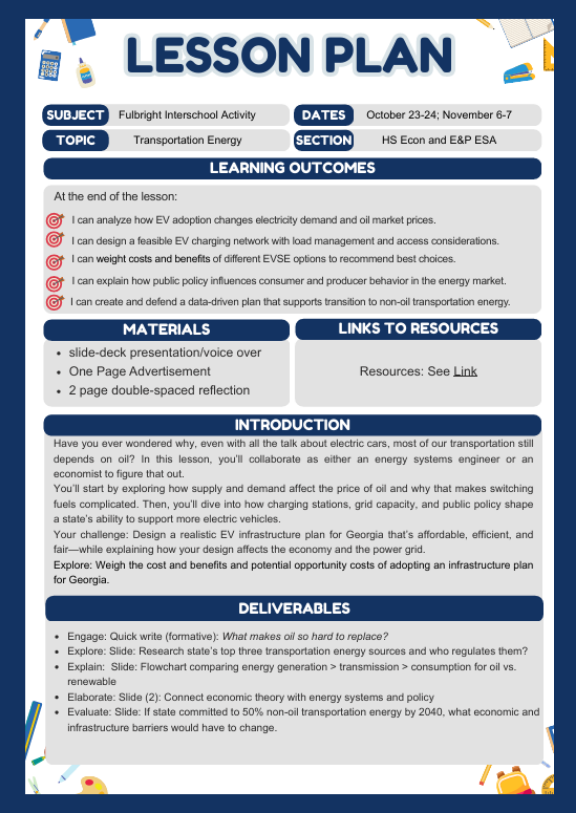
Try it: Ask students to investigate a real local problem using authentic tools and data, then consider how the same challenge appears in other communities. In this project, students evaluate a local EV charging site using mapping, infrastructure, accessibility, and electrical-load data. Students are acting like consultants, selecting actual site and defending a recommendation.

Step 03: Use Comparison to Build Perspective
Present several regions rather than one “correct” context. Students in this interdisciplinary Energy Systems & AP Human Geography lesson analyze how development patterns relate to access to reliable, sustainable energy. Give students the same problem in different geographic, economic, or cultural contexts and require them to determine why the solution may change.


Step 04: Let Students Experience Another Perspective
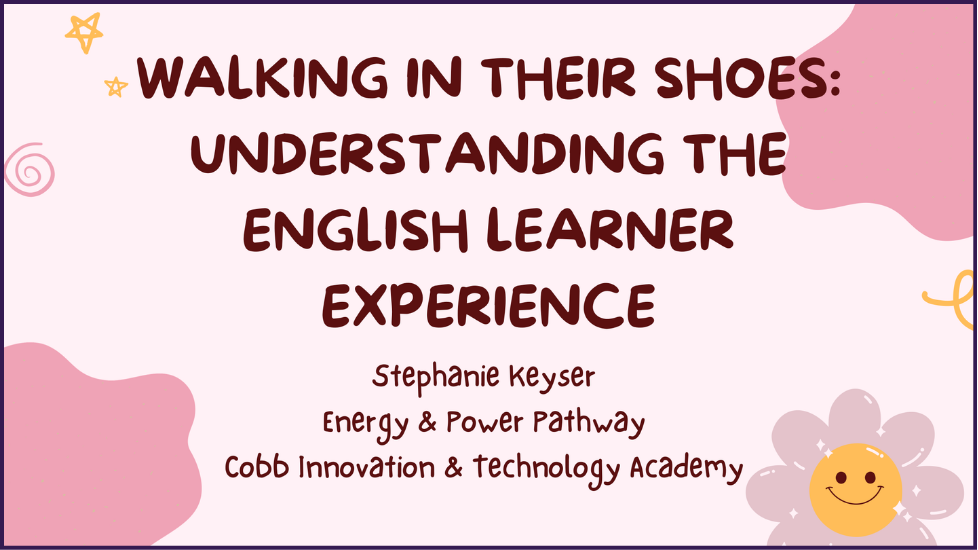
Try it: Use a simulation that temporarily changes the rules of communication, access, or participation, then debrief the experience. Walking in Their Shoes uses communication-limited activities to help educators consider what multilingual learners may experience when classroom expectations are not accessible.
The key is to DEBRIEF after the activity.
Step 05: Build Reflection into the Routine
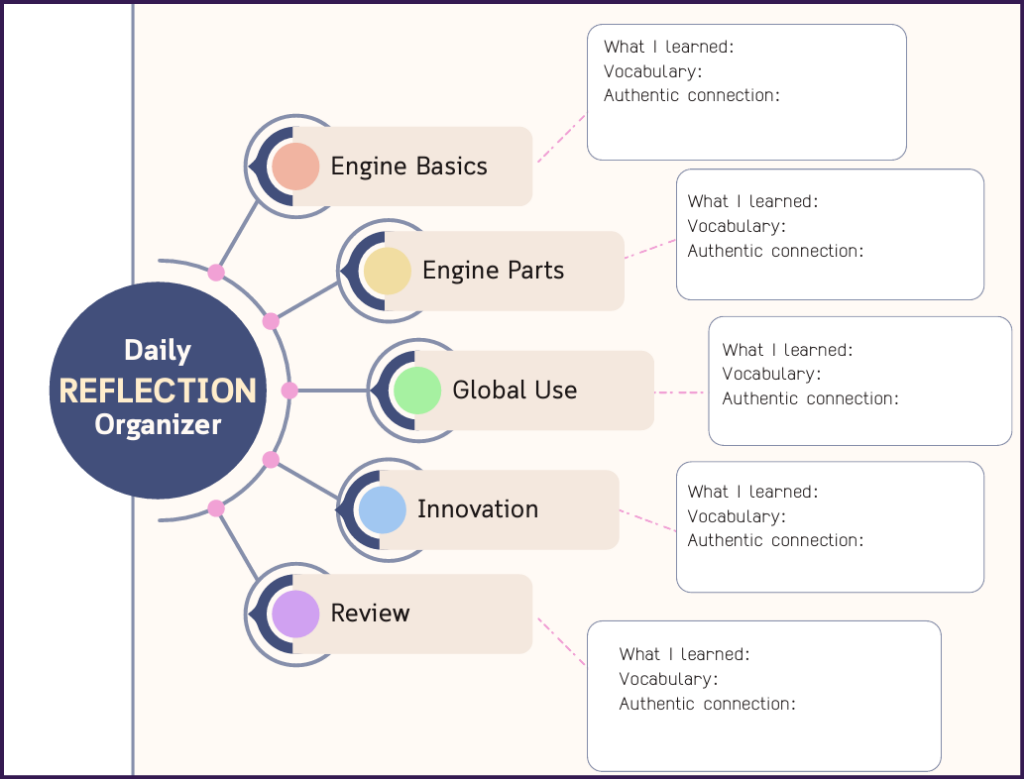
Try it: Add one recurring prompt to an existing warm-up, exit ticket, notebook, or reflection: What is the authentic connection? Your organizer repeats that prompt across engine basics, engine parts, global use, innovation, and review.
Global thinking does not have to happen only during large projects.
Step 06: Turn Local Experience into Global Learning
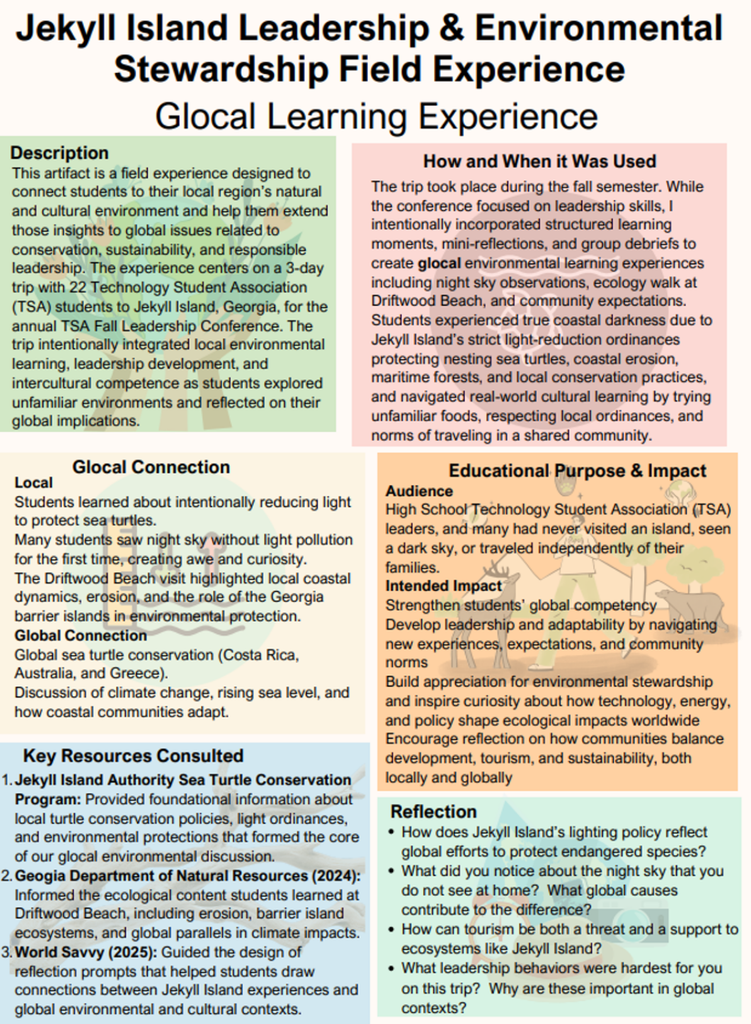
Try it: Take something students can observe locally-an environmental policy, business, infrastructure system, cultural practice, or community issue-and ask, Where else does this happe? How is it handled there? A local field experience can become global when students investigate how the issues they observe connect to systems, challenges, and communities elsewhere.
Inter-School Collaboration
Transportation Energy: Economics x Energy Systems


HOW IT WORKED:
This Fulbright inter-school activity connected my Energy & Power students with high school Economics students at another school. My partner teacher and I first met virtually to brainstorm possible connections between our courses and ultimately chose transportation energy and EV infrastructure because the topic required students to consider both technical and economic systems.
We divided responsibility according to our areas of expertise and developed a shared plan, timeline, formative assessments, and final products. Students from both schools were placed into collaborative groups and worked together through Google Meet. Economics student examined supply and demand, costs, incentives, opportunity costs, and public policy, while Energy & Power students investigated charging infrastructure, grid capacity, load management, and technological constraints. Their culminating task was to create a collaborative Canva presentation proposing and defending a realistic future transportation-energy plan. The lesson included formative checks throughout and a summative presentation with written reflection.
WHAT I LEARNED:
One of the strongest parts of the experience was the partnership between the two teachers. We worked extremely well together, maintained the schedule and instructional plan we created, and each contributed to the content expertise necessary for the project. Even when the first student meeting did not go as planned, we adjusted together rather than abandoning the collaboration.
Students were surprised by differences they discovered between the locations, and the Boston students began extending their comparisons to surrounding states. Students also began to recognize that the cost and feasibility of a technology involve much more than the purchase price. Infrastructure, energy availability, policy, geography, and economic conditions all influence whether a solution will work in a particular place.
The experience also showed me how easily Energy & Power can connect with other disciplines. Working successfully with an Economics teacher inspired me to develop a later interdisciplinary lesson with an AP Human Geography teacher at my own school.
CHALLENGES & NEXT STEPS
Our first online student meeting was chaotic. Students experimented with virtual backgrounds and treated the meeting more casually than we anticipated. Before the next collaboration, we established clearer expectations and ground rules, which significantly improved the experience.
Scheduling was another challenge. My classes follow a fixed schedule while my partner’s school schedule changed from day to day, so coordinating shared meeting times required flexibility. Interestingly, I later encountered a similar scheduling structure while in Uruguay, which gave me another perspective on the logistical challenges of collaborating across different educational systems.
Despite those challenges, the collaboration was successful enough that we plan to continue the partnership. In future projects, we will establish virtual collaboration norms before the first student meeting and build greater scheduling flexibility into the plan from the beginning.
Digital Tools for Global Energy Learning
Digital tools can help students investigate authentic energy problems, analyze real-world conditions, compare locations, and communicate evidence-based solutions. These are five tools I recommend for connecting Energy Systems instruction with geographic, environmental, economic, and global perspectives.
ArcGIS: Map Systems and Infrastructure
ArcGIS allows students to visualize and analyze information geographically, combining layers of data to reveal patterns and relationships. ESRI specifically supports K-12 use of interactive maps, spatial analysis, data collection, and student-created mapping projects.
How To Use It:
Students can map energy-generation sites, transmission infrastructure, EV charging networks, population patterns, natural resources, or other variables and investigate why particular energy solutions make sense in some locations but not others.
Global Connection:
Students can compare energy resourcs and infrastructure across communities, states, and countries and see how geograpphy influences energy decisions.
SunCalc: Investigate Solar Potential
SunCalc shows the path and position of the sun for a selected location and data, including sunrise and sunset, solar altitude and azimuth, shadow length, daylight duration, and solar information useful for investigating photovoltaic applications.
How To Use It:
Students can compare potential solar sites, investigate seasonal changes in sunlight, consider panel orientatl, and examine why the same solar-energy system may perform differently in different locations.
Global Connection:
Changing the location allows students to compare solar conditions around the world and connect latitude, season, geography, and energy-resource potential.
Global Wind Atlas: Analyze Wind-Energy Potential
The Global Wind Atlas allows users to investigate wind speed, wind-power density, terrain conditions, and wind-energy potential around the world. Users can compare countries and regions, examine different turbine heights, define custom areas, and even perform preliminary annual-energy-production calculations.
How To Use It:
Students can identify potential locations for wind-energy development and use actual wind-resource data to defend why one site may be more appropriate than another.
Global Connection:
Because the data are global, students can compare wind resources in Georgia with locations in other parts of the United States or the world and investigate how physical geography affects energy development.
Canva: Communicate Solutions
Canva allows students to create presentations, infographics, videos, posters, websites, and other visual products. Canva Education also supports student collaboration, assignments, feedback, and classroom integration.
How To Use It:
Students use Canva to synthesize research and communicate technical information to an audience. For example, students in my inter-school Energy and Economics collaboration used Canva to present and defend their proposed transportation-energy plans.
Global Connection:
Canva gives students an accessible way to communicate comparisons, data, recommendations, and proposed solutions to audiences beyond a traditional written assignment.
Nearpod: Make Learning Interactive
Nearpod allows teachers to combine instructional content with interactive media and formative assessment. Students can respond during live or self-paced lessons while teachers receive real-time information about student understanding.
How To Use It:
I use Nearpod to introduce concepts, embed questions and data interpretation throughout instruction, check student understanding, and create opportunities for students to respond before moving into larger investigations. I was able to use in the interschool lesson and give feedback to students many states away.
Global Connection:
Polls, open-ended questions, maps, images, and other interactive content can be used to introduce global issues and ask students to compare how different communities might approach the same challenge.
MY BIGGEST TAKEAWAY
Successful inter-school collaboration depends as much on the relationship and planning betwen teachers as it does on the lesson itself.